
FOR IMMEDIATE RELEASE – February 4, 2026
MEDIA CONTACT:
Jordan Uldrich, Nebraska Soil Health Coalition Board Member and Producer
Email: Uldrich_Jordan@hotmail.com
Phone: 402-366-4836
“My Window View as a Young Nebraska Producer”
As I travel the countryside near Geneva and my farm this winter, I’ve noticed something familiar but increasingly striking: an ever-increasing abundance of harvested corn acres. As a row crop farmer, I don’t just see residue — I see opportunity. By grazing corn stalks, I’m turning what’s left in the field into cash while reducing nutrient costs for my next crop. In this article, I will share my grazing practices, walk through the economics and explore how we can improve our land. But first, it helps to step back and remember the system that built the deep, productive soils we farm today.
Native Grazers Built Our Soil
More than 150 years ago, this ecosystem was a perennial tall grass prairie. Grazers played a critical role in shaping this system and way of life. According to the National Park Service, 30 to 60 million ruminants, or multi-stomachs — buffalo, deer, elk, sheep, cattle— once grazed these lands. They moved in massive herds, grazing non-selectively and at a thigh intensity. Predators influenced their movements as herds searched for water and followed seasonal peaks in forage. This constant motion allowed grasses and forbs periods of rest and recovery, an essential ingredient for healthy soils.
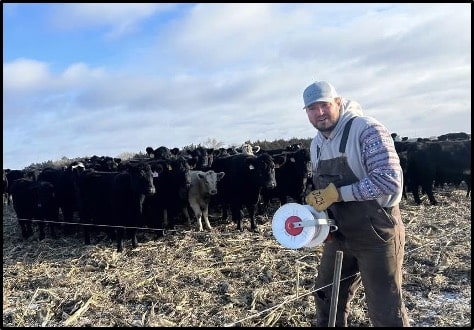
Jordan Uldrich, a producer near Geneva, prepares a harvested field for Adaptive Multi-Paddock (AMP) grazing, turning residue into feed while building soil health for the next crop.
When a ruminant grazes, its multiple stomachs process a wide range of diverse forages. Bacteria, fungi and other microbes break that fodder down into nutrients and carbohydrates that nourish the animal. What the animal can’t use — including much of that microbiology — comes out of the backside of a cow for free, and is naturally spread across the land as nutrient-rich manure.
Those old “buffalo chips” don’t just disappear. They inoculated the soil with organisms capable of fixing nitrogen, among other soil services. This may strike a chord as a part of discussions to reduce the need for high dollar nitrogen while enhancing net profitability and improving one’s soils. So how do we return our soils to a high-functioning state requiring fewer inputs? We emulate the system that built them.
Grazing With Intention
I, along with many others, use Adaptive Multi-Paddock (AMP) grazing to mimic the habits of buffalo and, in turn, we are fostering natural nutrient cycles. Through AMP grazing, I’ve seen reduced erosion, the reestablishment of native vegetation and less selective grazing. Case in point: I have personally watched cows willingly eat marestail (an invasive weed) in a fresh paddock of grass.
Two years ago, I had an epiphany and discussed an idea with fellow Nebraska Soil Health Coalition producers: Why limit grazing to pastures alone? I decided to experiment by applying AMP grazing to marginal corn stalks. Over one month, I grazed 30 pairs on 1.5 acres per day across a 25-acre irrigated field. I split thefield into strips and advanced the cattle through 250-foot widths as needed. The following season, I grew 155 bushels per acre of irrigated milo after the grazed corn. Thanks to the AMP system, I applied just 120 pounds of nitrogen, 20 pounds of sulfur and no additional nutrients — far less than a typical year.
The Numbers Matter
Milo’s typical nitrogen use efficiency (NUE) tends to be 1 to 1.1 pounds of nitrogen per bushel. My field achieved a NUE of just 0.77 pounds per bushel — a savings of more than 30 percent. That’s real money. I also saved more than $25 per acre on phosphorus. On top of that, I transformed my residue by turning it into pounds of beef and — just as importantly — adding significant amounts of manure to build organic matter. The University of Nebraska- Lincoln estimates the value of grazing corn stalks at $0.85 to $1.50 per head per day, which pencils out to roughly $50 per acre in added income for this field. Altogether, that’s a gross financial swing of more than $75 per acre.
Looking Back to Move Forward
In row-crop country, livestock is often one of the last items considered when discussing profitability. But as I reflect on our past, I am more convinced than ever that integrating livestock is an increasingly valuable tool for my farm.
After all, 150 years ago it was an ecosystem of plants and animals — like the buffalo —that built the soils we now farm. We can, and should, leverage those natural relationships to reduce costs and improve the sustainability of our land.
Remember, nature will work with you…if you let it.
About Nebraska Soil Health Coalition
The Nebraska Soil Health Coalition is a collaborative effort to increase sustainable agricultural production and thriving rural communities. As part of that vision, we support Nebraska’s community newspapers. Check out www.nesoilhealth.org.